
Webflow Pricing 2026 Explained: What Changed and What You Actually Need
Webflow's 2026 pricing overhaul explained plainly: new Site Plan tiers, Platform plans, Workspace seats, and which one fits your business.
Table of contents
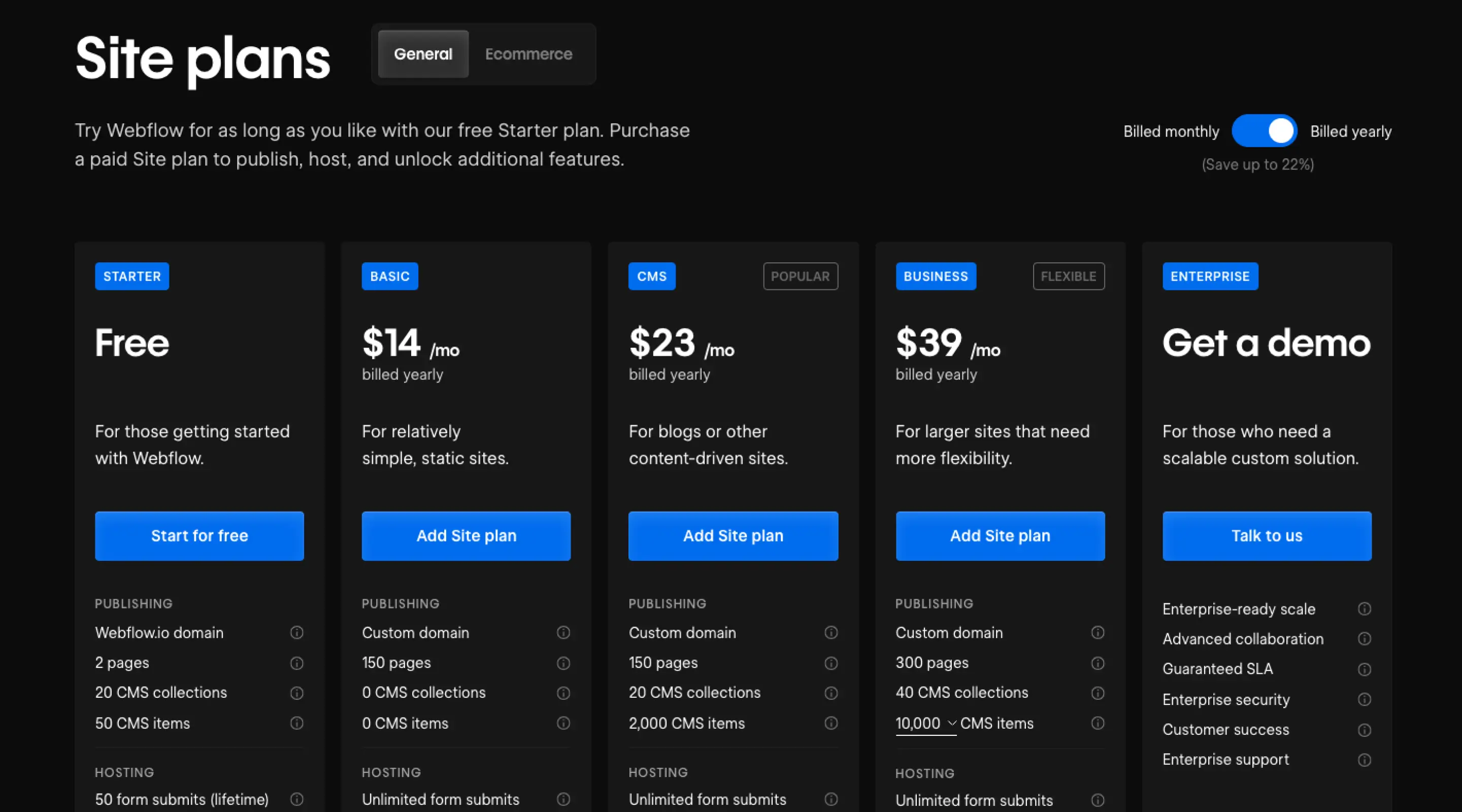
Webflow rebuilt its pricing on 13 May 2026. Site Plans dropped from four tiers to three: Starter (free), Basic (US$15/month, no CMS), and Premium (US$25/month, CMS included). The old CMS and Business plans are gone. Most Singapore SMEs now only need to choose between Basic and Premium, everything else, including the new US$2,500/month Team plan, is built for teams and enterprises, not a single business website.
've had three clients ask me some version of the same question this month: why does my Webflow quote suddenly look different from what I saw last year? The answer is that Webflow didn't just adjust its prices, it rebuilt the whole structure. Plans that existed for years are gone, a new tier appeared that most of my clients will never need, and the way CMS access is sold has changed entirely. I wrote the original version of this guide when the old four-tier system was still current. This is a full rewrite around what's actually live today.
If you read the old version of this article, or a Webflow pricing breakdown from before mid-2026, treat it as out of date. What follows is the current structure, what each tier costs, and, more usefully, which one you can ignore. As a Webflow design agency based in Singapore, this is the plan conversation I have with nearly every client before we start a build.
What Actually Changed in Webflow's 2026 Pricing
Three structural changes matter more than any individual price:
- Site Plans went from four tiers to three. Starter, Basic and CMS and Business are now just Starter, Basic and Premium.
- CMS access moved. It used to be its own mid-tier plan. It's now bundled into Premium, the top Site Plan tier, alongside a new AI Overview citation and search feature and code components.
- A new "Platform plan" tier appeared above Site Plans entirely. Team and Enterprise bundle a site, a Workspace, and a set of governance and publishing features that only make sense once you're managing multiple sites at scale.
Everything below reflects the live pricing page as of this rewrite. Webflow revises figures periodically, so treat this as accurate today and worth a quick re-check before you sign anything a year from now.
Webflow Site Plans: The New Three-Tier Structure
A Site Plan is what puts your website on a custom domain and keeps it live. Without one, your site only exists on a Webflow.io staging address, fine for building, not for a real business. Site Plans are billed per website, so three sites need three plans.
Starter Plan, Free
The free tier. It's for testing the platform or staging a design before launch, not for a live business site.
- Webflow.io subdomain only
- Limited CMS
- 2 static pages
- 1GB bandwidth
- 50 form submissions a month
- Webflow AI, MCP server access, and Webflow Cloud app hosting included
Basic Plan, US$15/month (billed yearly)
For simple sites that genuinely don't need a CMS: fixed pages like Home, About, Services and Contact, with no blog or dynamic content.
- Custom domain, SSL, CDN hosting
- 300 static pages
- 10GB bandwidth
- Unlimited form submissions
- Password protection
- Webflow AI, MCP server access, Webflow Cloud app hosting
What it still lacks: the CMS. If a blog, case studies or a resources section are anywhere on your roadmap, Basic won't get you there and you'll be upgrading within the year.
Premium Plan, US$25/month (billed yearly)
This is the plan I now point most content-driven SME clients toward, and it's the one that absorbed the old CMS plan's job. It's built for sites with a CMS and real traffic.
- Everything in Basic
- Full Webflow CMS access
- Scalable bandwidth from 50GB up to 2.5TB via add-ons
- Code components
- Site search
- Form file upload
- Well-known files support
There's no separate "Business" tier above this anymore for high-traffic sites. If you outgrow Premium's included bandwidth, you add capacity as a line item rather than jumping to a whole new plan, more on that in the add-ons section below.
Site Plan Comparison
Ecommerce Plans
Ecommerce plans replace, rather than stack on top of, a standard Site Plan, and pricing here hasn't changed: Standard at $29/month for stores under 500 items with a 2% transaction fee, Plus at $74/month for up to 5,000 items with no transaction fee, and Advanced at $212/month for 15,000 items and unbranded checkout emails. If you're selling online, this is still the section to budget from, not Basic or Premium.
Platform Plans: The New Team and Enterprise Tier
This is the biggest structural addition, and also the one most of my clients can safely skip. A Platform plan bundles a Site Plan, a Workspace, and a set of collaboration and governance features into one contract. Team runs US$2,500/month on an annual contract and adds Webflow Localize, AI-driven answer engine optimisation agents, publishing workflows, single-page publishing, a site activity log and API access, plus priority support. Enterprise sits above it at custom pricing, adding granular permissions, custom roles, a dedicated account manager and formal SLAs.
If you're a single business commissioning one website, this tier isn't for you, it's priced for organisations running many sites across departments or brands that need centralised governance. I flag it here mainly so nobody mistakes the $2,500 figure for what a normal Webflow project costs.
Workspace Plans: Staging, Collaboration and Seats
Workspace Plans are a separate axis from Site Plans entirely. A Site Plan is what makes your site live. A Workspace is where the building happens, staging sites, collaborators and client access. Think of a Site Plan as the rented plot, and a Workspace as the toolbox and the team standing on it.
You need a paid Workspace if you're a freelancer or agency managing several client projects, or an in-house team collaborating on one site with multiple contributors. A single business owner who just wants a website built and handed over typically doesn't need one at all.
Workspace Plan Pricing
Seats: How Team Members Are Priced
On top of the Workspace tier, each person you add is billed as a seat: Full seats at $39/month for people designing full sites or managing admin settings, Limited seats at $15/month for editing content or building with existing components, and Free seats for reviewers and commenters who never touch the designer.
Do You Need Both a Site Plan and a Workspace Plan?
For most Singapore businesses commissioning a website build, no. Your agency runs the Workspace on their side. Once your site is handed over, you manage content through your own Site Plan's editor access, at no extra cost to you. The Workspace and seat pricing above only becomes relevant once you're the one running an agency, an in-house team, or managing several sites yourself.
Add-Ons: What's Now Priced Separately
A handful of features that used to be bundled into higher plan tiers are now optional add-ons. You won't need most of these on day one, but it's worth knowing they exist so a future upgrade doesn't come as a surprise:
- Extra bandwidth on Premium: starts at +50GB for $20/month (billed annually), scaling up to +2.45TB for $974/month for genuinely high-traffic sites.
- Optimize, from $299/month based on page views, for A/B testing and personalisation.
- Analyze, from $9/month based on sessions, for on-site analytics.
- Localize, from $9/month (Essential) or $29/month (Advanced) based on locales, for multi-language sites.
- AI credits, 2,000 credits/month for $20/month billed annually, for teams using Webflow's AI features heavily.
Webflow Pricing in Singapore: What Local Businesses Should Know
Webflow bills in US dollars, so Singapore businesses carry currency risk on top of the sticker price. At roughly SGD 1.36 to the US dollar, a Premium Site Plan lands around SGD 34/month billed annually, about SGD 408 a year, and a Basic plan around SGD 20/month, about SGD 245 a year. These will shift with the exchange rate, so treat them as a working estimate rather than a fixed number.
- GST applicability: Webflow charges GST where applicable. Check your billing settings to confirm compliance for a Singapore-registered entity.
- No local hosting option: Webflow runs on AWS and Fastly globally, there's no Singapore-specific data centre, though CDN edge nodes keep Southeast Asian performance strong in practice.
- Payment methods: major credit cards and Stripe billing are supported. Local bank transfer or PayNow aren't currently accepted directly.
- Enterprise pricing: available for larger organisations or regulated entities with compliance requirements, relevant if you're a financial services firm weighing a migration, a topic I've covered separately for that sector.
How to Choose the Right Plan: A Simple Decision Guide
A quick way to cut through the tiers:
- Just testing or staging a design? Starter, free.
- Fixed pages, no blog, no dynamic content? Basic, $15/month.
- Want a blog, case studies, or any CMS-driven content? Premium, $25/month, this is where most SME sites land.
- Selling products online? Skip Site Plans entirely and go straight to an Ecommerce plan.
- Managing several client sites or a multi-person in-house team? Add a Workspace plan and the relevant seats on top of your Site Plan.
- Running governance across many sites at enterprise scale? That's the Team or Enterprise Platform plan, and you'll know if you're that organisation.
The True Cost of Webflow vs Other Platforms
Comparing Webflow's headline price to a basic WordPress hosting plan misses most of the real cost. A Premium Site Plan at $25/month can look expensive next to $5 hosting, until you add what WordPress actually costs to run properly: premium themes and page builders often $50 to $200 a year each, security plugins upward of $100 a year, performance plugins on top of that, and developer time every time a plugin update breaks something.
Webflow folds all of that into one subscription. No plugin conflicts, no manual security patching, no theme licence renewals to track. Over a two to three year horizon, that consolidation usually comes out ahead, even before accounting for the hours saved.
Against Wix, the gap is less about total cost and more about ceiling: Webflow gives you far more design control, stronger native SEO, and an architecture that doesn't need to be rebuilt when your business outgrows a template.
What Every Paid Site Plan Includes, Regardless of Tier
A few things are standard across Basic and Premium alike: free SSL, global CDN hosting via AWS and Fastly, automatic backups, custom domain connection, form submissions, and the SEO controls (meta tags, Open Graph, sitemaps, robots.txt) that make Webflow's built-in SEO one of its stronger selling points.
That native SEO toolkit is part of why SEO-focused agencies tend to prefer building on Webflow over platforms that need a plugin stack to reach the same baseline, and it's a theme I go into more in my dedicated guide to Webflow SEO for Singapore businesses.
Is Webflow Maintenance an Additional Cost?
One question I get from nearly every Singapore client: does the plan price cover ongoing Webflow maintenance? Platform maintenance, hosting uptime, security patching, CDN performance, is fully managed by Webflow and included in your Site Plan. You won't be patching a server yourself.
Content updates, design changes and ongoing SEO work are a different budget line entirely. If your team can't absorb those in-house, a maintenance retainer covers that gap. Mine start at SGD 650/month for up to five content requests a month, separate from whatever Site Plan you're on.
How I Help Clients Pick a Plan
When I scope a new Webflow project, plan selection is one of the first conversations, and the most common misconception hasn't changed even though the plans have: people assume they need the most expensive tier available. In practice:
- Most Singapore SMEs land comfortably on Premium at $25/month, it's the plan built for exactly their use case now.
- A genuinely static, no-blog business can start on Basic and upgrade later if content plans change.
- Ecommerce businesses should map their catalogue size against Standard before assuming they need Plus.
If you're still weighing whether Webflow is the right platform at all before getting into plan tiers, that's a separate question I've answered in full in why Webflow is worth it for your specific use case.
Frequently Asked Questions
Can a free Starter Workspace sit alongside a paid Premium Site Plan?
Yes, and this trips people up because it feels like it shouldn't work. Site Plans and Workspace plans are billed on entirely separate axes. A solo founder can run a free Starter Workspace for staging and collaboration while their published site sits on a paid Premium plan, there's no requirement to upgrade the Workspace just because the site itself is paid.
What does Team actually give you that buying Premium plus a paid Workspace doesn't?
It's not just a bundle discount. Team includes features that aren't sold separately at any price on Site or Workspace plans alone, Webflow Localize, AEO agents, single-page publishing, a site activity log with API access, and priority support. Combining Premium and an Agency Workspace gets you the CMS and the collaboration tools, but not that governance and publishing layer, that's the actual product difference, not just a bigger invoice.
Do ecommerce items count against my CMS item limit?
No. Products, variants and categories on an ecommerce plan are tracked as a separate allowance from your CMS items. A store can be near its ecommerce item ceiling while its blog or resources section, running on the same CMS, still has plenty of room left.
Can I upgrade or downgrade my Site Plan later?
Yes, at any time. Upgrading mid-cycle charges the pro-rated difference immediately. Downgrading takes effect at your next billing date rather than instantly. There's no long-term lock-in on Site Plans themselves, unlike Team, which requires an annual contract.
What happens if I cancel my Site Plan?
Your site reverts to Starter. The custom domain stops resolving and the site becomes reachable only on its Webflow.io staging URL. Nothing is deleted, your content, CMS data and design stay in your account, but the public site goes dark until a paid plan is reinstated.
Where This Leaves You
If you're mid-quote or mid-project right now, the practical move is simple: check which Site Plan tier your build actually needs against the table above, most SME sites land on Premium, and ignore anything above it unless you're genuinely managing a multi-site organisation. If you're comparing agencies, ask them to name the specific plan tier in their quote rather than a rough monthly figure, the difference between Basic and Premium alone is $10 a month but the CMS gap between them is the difference between a static brochure and a site you can actually grow.
If your business has outgrown its current plan, or you're not sure which tier your existing site is even on, that's worth a five-minute check before you're surprised by a bandwidth add-on charge later. I go through this exact plan-fit conversation with every new client before we start building, and I'm happy to do the same for you, whether you're starting a new Webflow site or auditing what you're already paying for.
{{build-better-experience="/directory"}}
Categories
Written By

Resources
Related Articles
Deep dive into our latest news and insights.


.webp)
.avif)